
Entertaining · 10 min read
The Lowcountry Porch Party: Shade, Sound, and Seating That Works
Your existing entertaining articles cover table setting and watch parties. This one is about the thing nobody talks about until they're standing in 95°F heat wondering why their guests are huddled under the one ceiling fan that works – porch-specific hosting in summer heat. Shade, sound, and seating. Get those three right and everything else falls into place.
Shade: The #1 Challenge for Lowcountry Hosts
Here's the truth about summer entertaining on Hilton Head Island: between May and September, the sun is the uninvited guest that ruins the party. Afternoon temperatures push past 90°F, humidity hovers above 80%, and the UV index regularly hits “extreme.” If your porch or pool deck doesn't have a shade strategy, your guests will migrate indoors within 30 minutes – no matter how beautiful the setup.
The good news: shade is a solvable problem. The key is matching your shade solution to your specific space, your sun exposure, and the time of day you typically entertain.
Sun Mapping: Know Your Exposure Before You Buy Anything
Before you invest in shade, spend one weekend mapping how the sun moves across your outdoor space. This takes five minutes, three times a day, and it will save you from buying the wrong solution.
- Morning (8–10 AM): Where does the sun hit? Most east-facing porches are pleasant in the morning but fully exposed by noon. If you entertain for brunch, morning shade may not be a priority.
- Midday (12–2 PM): This is the critical window. The sun is directly overhead and at its most intense. Note which areas of your porch, patio, or pool deck are in full sun versus partial shade from your roofline, trees, or existing structures.
- Afternoon (4–6 PM): The golden hour for Lowcountry entertaining. West-facing spaces get hammered by low-angle sun that slips under pergolas and rooflines. This is where most shade strategies fail – the sun comes in sideways, not from above.
Once you know your exposure pattern, you can choose the right shade solution for each zone of your outdoor space.
Poolside Shade: Shibumi for the Win
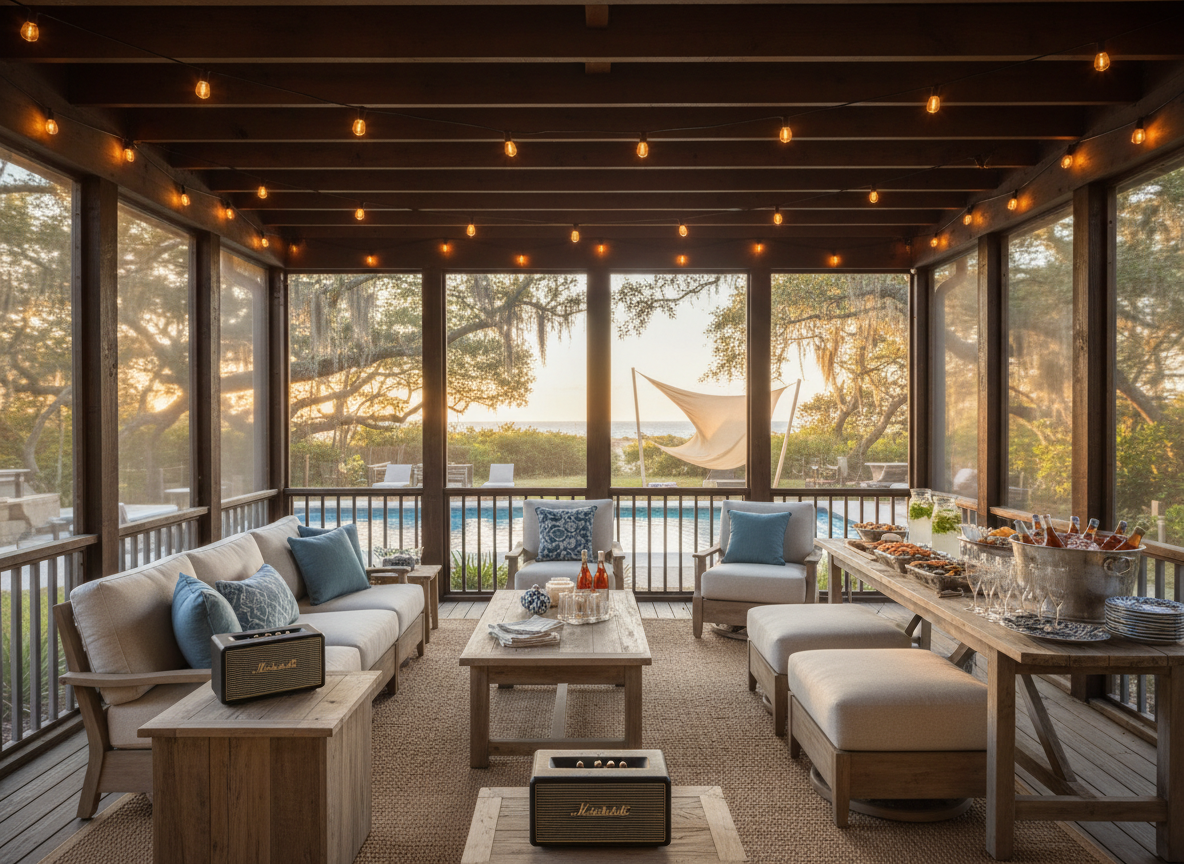
If you have a pool or an open lawn area adjacent to your porch, a Shibumi Shade is the most elegant solution available. Designed in Raleigh, North Carolina, Shibumi uses the ocean breeze itself to create a graceful, billowing canopy – no poles to wrestle with, no anchors to fight, no complicated setup.
Plant the pole, unfurl the canopy, and let the wind do the rest. The shade adjusts naturally as the breeze shifts, and it packs down in seconds when the party moves inside. For poolside entertaining on Hilton Head Island, where afternoon sea breezes are reliable from May through October, Shibumi is practically purpose-built.
Pair it with Shibumi's matching beach chairs for a setup that looks as beautiful as it functions. Your guests will ask about it – guaranteed.
Porch Shade: Umbrellas vs. Pergola Fans
For covered or semi-covered porches, the shade equation is different. You already have a roof – the challenge is the low-angle afternoon sun that slips underneath, and the trapped heat that builds under a solid roof with limited airflow.
Cantilever umbrellas are the most flexible solution for porch edges and open areas where the roof doesn't reach. A quality 10–11 foot cantilever umbrella with a UV-resistant Sunbrella canopy can shade a dining table and surrounding seating without a center pole blocking the conversation. Position them on the west side of your porch to block that brutal late-afternoon sun.
Pergola fans are the secret weapon for covered porches. A large outdoor ceiling fan (60–72 inches) mounted under a pergola or porch roof creates a wind-chill effect that drops the perceived temperature by 8–12 degrees. In the Lowcountry's humid heat, moving air matters more than shade alone. If you have a covered porch and no ceiling fan, that's the single highest-impact upgrade you can make for summer entertaining.
The combination play: For the Renovation Visionary planning a new porch or patio, the ideal setup is a solid roof with ceiling fans for the primary entertaining area, plus a Shibumi or cantilever umbrella for the pool deck or lawn extension. This gives you shade coverage from morning through evening, with airflow where it matters most.
Sound: Turtlebox Placement for Outdoor Acoustics
Music is the invisible architecture of a great party. Get it right and people relax, conversations flow, and the evening takes on a rhythm that feels effortless. Get it wrong – too loud, too quiet, tinny speakers that distort in the breeze – and the atmosphere never quite lands.
For outdoor entertaining on Hilton Head Island, you need a speaker that's built for the outdoors – not a living room speaker you've dragged onto the porch. That's where Turtlebox comes in.
Why Turtlebox Works Outdoors
Turtlebox speakers are designed, engineered, and customized in Houston, Texas specifically for outdoor environments. They're truly waterproof (IP67-rated), shockproof, and tuned for open-air acoustics – meaning the sound is clear and full even with wind, ambient noise, and the natural sound-absorption of outdoor spaces.
The battery life is measured in days, not hours. You'll never be caught mid-playlist looking for an outlet. And the Bluetooth range is generous enough that your phone can stay in your pocket while you work the grill or greet guests.
Placement: The Difference Between Background Music and a Soundtrack
Where you place your Turtlebox matters more than which playlist you choose. Here's how to think about outdoor speaker placement for a porch party:
- Elevate it. Sound travels better when the speaker is at ear level or slightly above. Place your Turtlebox on a console table, a bar cart, or a shelf – not on the ground. On a porch, a side table near the seating area works perfectly.
- Face it toward the gathering. Outdoor spaces don't have walls to bounce sound around. Point the speaker toward the primary seating or conversation zone so the sound reaches your guests directly rather than dissipating into the yard.
- Keep it away from the grill station. During the cooking phase, set the Turtlebox near the cook so they can enjoy music while prepping. Once guests arrive, move it to the main entertaining area. The portability is the whole point – use it.
- Two speakers for larger spaces. If you're hosting more than 12–15 people across a large porch and pool deck, consider pairing two Turtlebox speakers. Place one near the porch seating and one near the pool or lawn area. This creates even coverage without cranking the volume on a single unit.
Volume: The Golden Rule
Here's the rule that separates a great host from a good one: if your guests can identify the song playing, the music is too loud for a dinner party. Background music should be felt, not listened to. It fills the silences between conversations without competing with them.
For a cocktail hour or casual gathering, you can push the volume slightly higher – enough that people can hear the music when they're not talking, but it drops to background the moment a conversation starts. Turtlebox's clean output makes this easy – even at lower volumes, the sound is full and warm, not thin or tinny.
For a seated dinner, drop it another notch. The music should be a whisper – just enough to prevent that awkward silence when someone pauses mid-story. Jazz, acoustic, or instrumental playlists work best. Save the upbeat stuff for after dessert when the evening shifts from dinner to drinks.
Seating: Conversation Zones, Swivel Chairs, and the Math That Matters
Most people think about seating last. They buy a dining set, arrange it on the porch, and call it done. But seating is the single biggest factor in whether your guests stay for one hour or four. The right arrangement creates natural conversation, easy flow, and the kind of comfort that makes people forget they're outside in the Lowcountry heat.
Conversation Zones: Design for How People Actually Gather
A great porch party doesn't happen in one spot. It happens in clusters – two people talking by the drink station, four gathered around the fire table, six at the dining table, a couple in the corner catching up. Your seating should create these zones naturally, not force everyone into a single arrangement.
The primary zone is your main conversation area – typically a deep-seating sofa and chairs arranged in a U-shape or L-shape. This is where the evening starts and where it ends. Lloyd Flanders' all-weather wicker deep-seating collections are ideal for this zone – the cushions are genuinely comfortable for hours, the wicker is elegant enough for any Hilton Head Island porch, and the aluminum frames handle coastal conditions without a second thought.
The secondary zone is a smaller grouping – two or three chairs around a side table or fire feature. This is where quieter conversations happen, where someone steps away from the main group for a one-on-one. O.W. Lee's fire tables are the perfect anchor for this zone – dramatic enough to draw people in, intimate enough to encourage real conversation.
The transition zone is the space between the kitchen/grill area and the seating. This is where people naturally congregate while food is being prepared. A bar-height table or a console with drinks and appetizers gives them a reason to linger without crowding the cook.
Swivel Chairs: The Unsung Hero of Porch Entertaining
If there's one piece of furniture that transforms a porch party, it's the swivel chair. A standard chair faces one direction – you're locked into whatever conversation is happening in front of you. A swivel chair lets you pivot between the main conversation, the side table, the view, and the person who just walked in – all without getting up.
For a Lowcountry porch where the view is half the reason you're outside, swivel chairs let your guests enjoy the marsh, the pool, and the conversation simultaneously. Lloyd Flanders and O.W. Lee both offer stunning swivel rocker and swivel glider options that combine this functionality with the comfort and coastal durability your Hilton Head or Bluffton porch demands.
Pro tip: Place swivel chairs at the corners of your conversation zone. This lets the people in those seats serve as “connectors” between groups – they can pivot to join either conversation, which keeps the energy flowing and prevents the party from splitting into isolated clusters.
How Many Seats Do You Actually Need?
This is the question every host gets wrong. The instinct is to count your guest list and buy that many chairs. But outdoor parties don't work that way – people stand, they move, they perch on armrests and lean against railings. Here's the real math:
- For 6–8 guests: You need 6–8 dedicated seats. At this size, everyone will sit at some point, and you want enough seats so no one feels like they're taking someone else's spot. A deep-seating sofa (seats 3), two swivel chairs, and 2–3 dining chairs covers it.
- For 10–15 guests: You need 8–10 dedicated seats plus standing room. At this size, not everyone sits at the same time. Focus on comfortable seating for 8–10, with a bar-height table or console that accommodates 4–5 standing guests comfortably.
- For 20+ guests: You need 12–15 dedicated seats plus ample standing zones. The seating becomes anchor points that people rotate through, not permanent assignments. Add Adirondack chairs along the porch edges for overflow – Berlin Gardens' poly lumber Adirondacks are perfect for this because they're lightweight enough to rearrange and tough enough to handle heavy use.
The key insight: always have 60–70% as many seats as guests. This creates natural movement and flow. If you have a seat for every single person, the party becomes static – everyone sits down and stays put. A slight seat deficit keeps people moving, mingling, and discovering different zones of your space.
Finishing Touches: Serving Pieces, Ice Stations, and the Details That Elevate
Shade, sound, and seating are the foundation. The finishing touches are what make your guests feel like they've stepped into something special – the kind of evening they'll talk about for weeks.
Serving Pieces That Go from Kitchen to Table
The best porch party serving pieces are beautiful enough to present and tough enough to handle outdoor conditions. This is where Smithey Ironware and Made In Cookware earn their place.
Smithey cast iron is handcrafted in Charleston, South Carolina – right here in the Lowcountry. Their hand-polished skillets and Dutch ovens go from the grill to the table with the kind of drama that makes people lean in. A Smithey No. 12 skillet loaded with shrimp and grits, set on a trivet in the center of the table, is both a serving vessel and a centerpiece. The cast iron holds heat beautifully, keeping food warm throughout the meal without a warming tray in sight.
Made In Cookware brings professional-grade stainless steel to your outdoor kitchen. Their serving bowls, sheet pans, and roasting pans are crafted in American factories with the same quality used in Michelin-starred restaurants. For a porch party, a Made In sheet pan loaded with grilled vegetables or a stainless bowl of summer salad looks polished and intentional – a step above the usual plastic serving ware.
The Ice and Drink Station
A self-serve drink station is the single most effective way to reduce your workload as a host. Set it up before guests arrive and you'll never have to ask “can I get you something?” – they'll help themselves, which is exactly what you want.
- Location: Place the drink station at the edge of your primary conversation zone – close enough that guests can grab a refill without leaving the party, far enough that it doesn't block traffic flow. A console table or bar cart works perfectly.
- Ice: More than you think. In Lowcountry summer heat, ice melts fast. Plan for 1.5 pounds of ice per guest for a 3–4 hour party. Use a large galvanized tub or an insulated cooler – not a bowl that'll be a puddle in 30 minutes.
- Glassware: Stemless wine glasses and lowball tumblers are the safest choices for outdoor entertaining. They're less likely to tip, easier to hold, and look relaxed without looking casual. Set out more glasses than you think you'll need – people set them down and forget where.
- A signature pitcher: One pre-made cocktail or mocktail in a beautiful pitcher eliminates 80% of drink requests. Bourbon peach sweet tea, cucumber gin fizz, or a simple sparkling water with citrus and herbs. Make it ahead, keep it cold, and let it do the work.
The Renovation Visionary's Takeaway: Design a Porch Built to Host
If you're planning a new porch, a renovation, or a major outdoor living upgrade on Hilton Head Island or in Bluffton, this article is your design brief. Here's what to tell your builder:
- Ceiling fans are non-negotiable. Specify at least one 60–72 inch outdoor-rated ceiling fan for every 400 square feet of covered porch. This is the single highest-impact comfort feature for summer entertaining in the Lowcountry.
- Plan electrical for speakers and lighting. A weatherproof outlet near the primary seating zone eliminates the need for extension cords. Add a dimmer-controlled circuit for string lights or sconces – lighting control is what separates a porch from an outdoor room.
- Build in a drink station. A built-in console, wet bar, or even a simple countertop with an under-counter refrigerator and ice maker transforms your hosting capacity. If you're building from scratch, this is a modest addition that pays enormous dividends.
- Design for multiple conversation zones. A 12×20 porch can support two distinct seating areas if the furniture is scaled correctly. Work with your furniture selections early – before the dimensions are finalized – so the space is designed around how you'll actually use it.
- Specify shade for the west side. If your porch faces west or southwest, plan for retractable screens, exterior shades, or a pergola extension on that side. The late-afternoon sun is the #1 comfort killer for Lowcountry porches, and it's much easier to solve during construction than after.
This is exactly the kind of planning we help with at Terrace + Tide. We work directly with builders, designers, and homeowners across Hilton Head Island and Bluffton to coordinate furniture, accessories, and outdoor living products with your construction timeline – so your porch is ready to host from day one.
The Porch Party Checklist
Here's everything you need for a Lowcountry porch party that runs itself:
- Shade: Shibumi for poolside, cantilever umbrellas for porch edges, ceiling fans for covered areas
- Sound: Turtlebox speaker elevated and facing the conversation zone, volume at “felt, not heard”
- Seating: Lloyd Flanders deep seating for the primary zone, O.W. Lee swivel chairs and fire table for the secondary zone, Berlin Gardens Adirondacks for overflow
- Serving: Smithey cast iron for grill-to-table drama, Made In stainless for polished presentation
- Drinks: Self-serve station with ice, glassware, and a signature pitcher
- Lighting: String lights overhead, candles on tables, lanterns at the perimeter
- Bug control: Citronella candles at the edges, ceiling fans running (moving air deters mosquitoes)
Get these right and the rest takes care of itself. Your guests will stay longer, talk more, and leave thinking you're the best host on Hilton Head Island. You don't have to tell them how simple it actually was.
Products Featured in This Article
Design Your Perfect Porch for Hosting
Visit our Hilton Head Island showroom to see Lloyd Flanders seating, O.W. Lee fire tables, Shibumi shades, Turtlebox speakers, and Smithey cookware – everything you need to host beautifully this summer.
Schedule a Consultation