
Grilling · 10 min read
The Reverse Sear: A Step-by-Step Guide to the Perfect Steak on the Grill
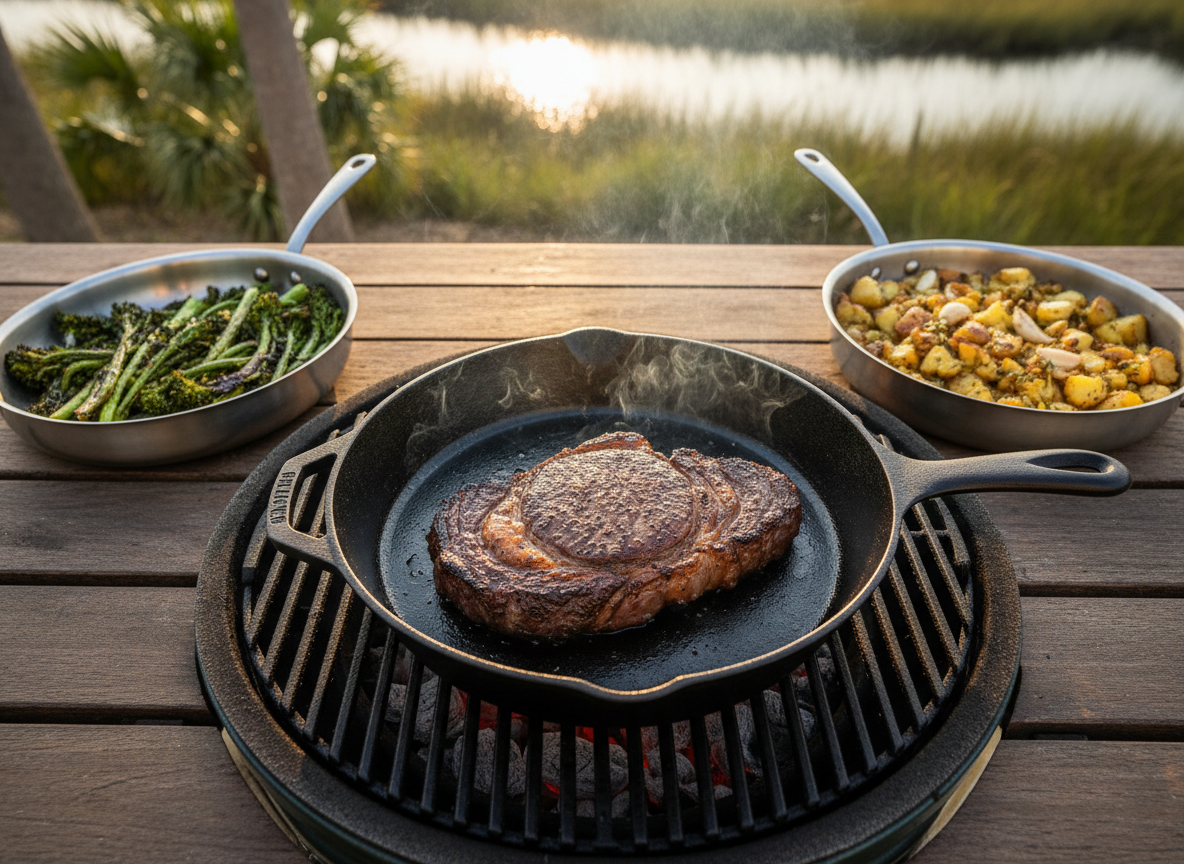
The reverse sear is the most talked-about technique in grilling communities right now – and for good reason. It produces a steak with edge-to-edge medium-rare perfection and a crust that rivals the best steakhouses. Here's how to do it on the Big Green Egg with a Smithey cast iron finish, plus two side dishes timed to hit the table together.
Why the Reverse Sear Changes Everything
The traditional approach to steak – sear first, then finish over indirect heat – works. But it leaves you with a thick gray band of overcooked meat between the crust and the pink center. The reverse sear flips the process: you bring the steak up to temperature slowly with low, indirect heat first, then finish with a screaming-hot sear at the very end.
The result is transformative. The interior is uniformly pink from edge to edge – no gray band, no guesswork. The surface is bone-dry after the low-heat phase, which means the Maillard reaction happens faster and more intensely during the sear. You get a deeper, more flavorful crust in less time, with less risk of overcooking.
For the Hilton Head homeowner who takes outdoor cooking seriously, the reverse sear is the technique that separates a good steak from an unforgettable one. And when you pair the Big Green Egg's precision temperature control with a Smithey cast iron skillet for the sear, you're working with the best tools available for the job.
Choosing the Cut: Ribeye vs. New York Strip
The reverse sear works best on thick steaks – 1.5 inches minimum, 2 inches ideal. Thin steaks cook through too quickly during the low-heat phase to benefit from the technique.
Ribeye is the classic choice. The generous marbling bastes the meat from within during the slow cook, and the fat cap renders beautifully. A bone-in ribeye (sometimes called a cowboy cut) adds even more flavor and makes for a dramatic presentation. Look for USDA Prime or upper Choice with visible marbling throughout.
New York strip is leaner and more uniform, with a firm, satisfying chew. The fat cap along one edge renders during the low-heat phase, and the tighter grain means clean, beautiful slices. It's the choice for cooks who prefer a slightly more structured bite.
Either cut works beautifully. The key is thickness. A 2-inch ribeye or strip gives you the widest window for a perfect interior – and the most dramatic contrast between the pink center and the dark, caramelized crust.
The Setup: Big Green Egg at 225°F Indirect
The Big Green Egg is the ideal cooker for the reverse sear because of one thing: precision. Its ceramic body holds temperature with almost no fluctuation, giving you the stable, low-heat environment the technique demands.
Set up the Egg for indirect cooking with the convEGGtor (plate setter) in place. Fill the firebox with natural lump charcoal – you won't need a full load for this cook. Stabilize at 225°F with the top and bottom vents barely cracked. This takes 15–20 minutes and is worth the patience. A stable Egg means a predictable cook.
Optional: Add one small chunk of post oak or hickory for a subtle smoke layer. The reverse sear isn't a smoking technique, but a whisper of wood smoke complements beef beautifully without overpowering it.
Phase 1: The Low-Heat Cook
Remove your steaks from the refrigerator 30–45 minutes before cooking. Season generously on all sides with kosher salt and coarsely ground black pepper. That's it – salt and pepper are all you need for a great steak. The seasoning draws moisture to the surface, which evaporates during the low-heat phase, creating the dry exterior that's essential for a perfect sear.
Place the steaks directly on the cooking grate over the convEGGtor. Insert a leave-in probe thermometer into the thickest part of the steak. Close the lid and walk away.
Target internal temperature: 115°F for a final result of medium-rare (after the sear adds another 10–15 degrees). This typically takes 45–60 minutes for a 2-inch steak at 225°F, but temperature is your guide, not time. Every steak is different.
For medium, pull at 125°F. For rare, pull at 105°F. The sear will add approximately 10–15 degrees to the final internal temperature.
When the steaks hit your target, remove them from the Egg and rest them on a wire rack while you prepare for the sear. This rest period is brief – 5–10 minutes – just enough time to get your Smithey skillet screaming hot.
Phase 2: The Smithey Cast Iron Sear
This is the moment. While the steaks rest, place your Smithey Ironware cast iron skillet directly on the Big Green Egg's cooking grate – remove the convEGGtor first and open the vents wide. You want the Egg as hot as it will go – 600–700°F. The Smithey's hand-polished surface and exceptional heat retention make it the ideal vessel for this final, critical step.
Add a thin film of high-smoke-point oil (avocado oil is ideal) to the skillet. When the oil just begins to shimmer and the faintest wisp of smoke appears, lay the steaks in the pan. You should hear an aggressive, immediate sizzle – if you don't, the pan isn't hot enough.
Sear for 60–90 seconds per side. Don't touch the steak once it's down – let the Maillard reaction do its work. Flip once. The crust should be deep mahogany, almost black in spots, with a satisfying crunch when you press it.
In the final 30 seconds, add 2 tablespoons of unsalted butter, 2 crushed garlic cloves, and a few sprigs of fresh thyme to the skillet. Tilt the pan and baste the steaks with the foaming, aromatic butter. This step is pure theater – and it adds a layer of richness that takes the crust from great to extraordinary.
Transfer the steaks to a cutting board and rest for 5 minutes. The carryover heat will bring the interior to a perfect 130–135°F – medium-rare, edge to edge.
The Sides: Timed to Hit the Table Together
A show-stopping steak deserves sides that arrive at the same moment. Both of these are cooked in Made In Cookware pans – their professional-grade stainless steel distributes heat evenly and handles the transition from grill to table beautifully.
Charred Broccolini with Lemon & Red Pepper Flakes
Serves 6 • 8 minutes active
- 2 bunches broccolini, trimmed
- 3 tablespoons extra-virgin olive oil
- 3 cloves garlic, thinly sliced
- ½ teaspoon red pepper flakes
- Juice of 1 lemon
- Flaky sea salt
Heat a Made In stainless steel skillet on the Egg's side grate (or on a side burner) over high heat. Add olive oil, then the broccolini in a single layer. Don't move it – let it char for 2–3 minutes until the tips are blackened and crispy. Flip, add garlic and red pepper flakes, and cook 2 minutes more. Finish with lemon juice and flaky salt. The broccolini should be tender-crisp with dramatic char marks.
Smashed Garlic Potatoes with Herbs
Serves 6 • 35 minutes total (mostly hands-off)
- 2 lbs baby Yukon Gold potatoes
- 4 tablespoons unsalted butter
- 3 tablespoons olive oil
- 4 cloves garlic, minced
- 2 tablespoons fresh rosemary, finely chopped
- Kosher salt and freshly cracked black pepper
- Flaky sea salt to finish
Boil the potatoes in salted water until fork-tender – about 15 minutes. Drain and let cool slightly. On a sheet pan, smash each potato with the bottom of a glass until about ½ inch thick. Drizzle generously with olive oil and season with salt and pepper.
Place the sheet pan on the Big Green Egg at 425°F (you can do this while the Egg is heating up for the sear phase) for 15–20 minutes until the edges are golden and crispy. In a Made In saucepan, melt butter with garlic and rosemary over low heat. Drizzle the herb butter over the finished potatoes and finish with flaky sea salt.
The Timing Chart: Everything Hits the Table at Once
This is the detail that separates a good cook from a great host. Here's how to time everything for a dinner for six so every element is ready simultaneously.
| Time | Action | Notes |
|---|---|---|
| T − 2:00 | Remove steaks from fridge, season generously | Salt & pepper, room temp rest |
| T − 1:30 | Light the Big Green Egg, stabilize at 225°F indirect | ConvEGGtor in place, vents barely cracked |
| T − 1:15 | Start boiling potatoes | Salted water, fork-tender in ~15 min |
| T − 1:10 | Steaks go on the Egg at 225°F | Probe thermometer in thickest part |
| T − 1:00 | Drain potatoes, smash, season, onto sheet pan | Set aside until Egg is ready |
| T − 0:20 | Steaks hit 115°F — pull and rest on wire rack | Remove convEGGtor, open vents wide |
| T − 0:15 | Potatoes go on the Egg at 425°F+ | Egg is heating up for sear — perfect for potatoes |
| T − 0:08 | Start charring broccolini in Made In skillet | High heat, don't move it |
| T − 0:05 | Smithey skillet on Egg, screaming hot. Sear steaks. | 60–90 sec per side, butter baste |
| T − 0:03 | Pull potatoes, drizzle herb butter | Melt butter with garlic & rosemary |
| T = 0:00 | Everything hits the table. Slice and serve. | 5-minute rest on steaks is built in |
Tips for Success
- Thickness is non-negotiable. The reverse sear only works on steaks 1.5 inches or thicker. Thin steaks will overcook during the low-heat phase before the interior has time to come up evenly.
- Trust the thermometer, not the clock. Every steak is different. Pull at your target internal temperature regardless of how long it's been on the Egg.
- Get the Smithey screaming hot. The sear phase is fast and violent. If the skillet isn't hot enough, you'll steam the steak instead of searing it. Wait for the oil to shimmer and the first wisp of smoke.
- Don't skip the butter baste. The combination of browned butter, garlic, and thyme in the final 30 seconds adds a layer of richness that makes the crust extraordinary.
- Rest after the sear. Five minutes on a cutting board lets the juices redistribute. Slice against the grain for maximum tenderness.
- Use the timing chart. The difference between a good dinner and a great one is having everything ready at the same moment. Print the chart and tape it to your outdoor kitchen counter.
The Presentation: A Dinner for Six That Looks Effortless
Slice the steaks against the grain into ½-inch strips and fan them across a warm Smithey skillet or a large wooden board. Arrange the charred broccolini alongside and pile the smashed garlic potatoes on the other side. Drizzle any remaining herb butter over the potatoes. Finish with a crack of black pepper and a scatter of flaky sea salt.
Bring the entire spread to the table at once. The Smithey holds heat beautifully, keeping the steak warm throughout the meal. The broccolini adds color and a bright, peppery counterpoint. The potatoes are crispy, buttery, and deeply satisfying.
Pour a bold Cabernet Sauvignon or a rich Malbec. This is the kind of meal that makes people put their phones down and pay attention.
Prep Time: 15 minutes (plus 30–45 min room temp rest)
Low-Heat Phase: 45–60 minutes
Sear: 3–4 minutes
Total Active Time: ~25 minutes
Serves: 6
Difficulty: Intermediate
Key Technique: Reverse sear (low heat first, then cast iron finish)
Products Featured in This Article
See the Big Green Egg & Smithey in Person
Visit our Hilton Head Island showroom for a live Big Green Egg demonstration. We'll help you choose the right Egg, skillet, and accessories for the way you cook.
Book a Grill Demo