
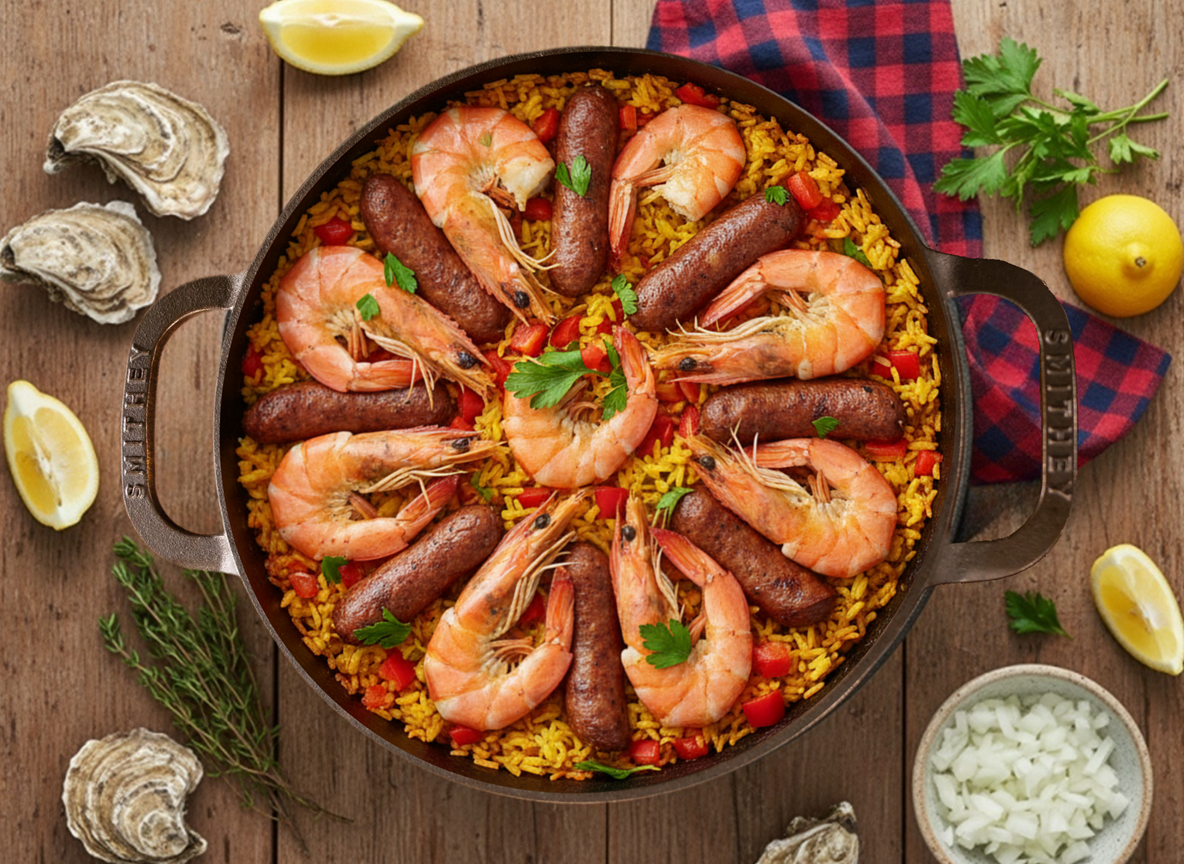
Paella is the kind of cook that commands attention. The moment that saffron-gold rice starts crackling against the cast iron, guests stop what they're doing and gather around the grill. This version – Gulf shrimp, andouille, and a proper socarrat – is cooked entirely outdoors on a Napoleon gas grill in a Smithey Ironware skillet. It's a showstopper that's more approachable than it looks.
Why This Works on the Grill
Traditional paella is cooked over an open wood fire – a wide, even heat source that heats the pan uniformly and allows the cook to control the intensity at every stage. Napoleon's multi-burner gas grills replicate this beautifully. With precise BTU control across independent burner zones, you can build the sofrito over medium heat, toast the rice over medium-high, and then drop to a steady low flame to develop the socarrat without scorching.
That final stage – the socarrat – is everything. It's the thin, caramelized crust of rice that forms on the bottom of the pan when the liquid has fully absorbed and the heat continues just long enough to toast without burning. It's the most coveted part of any paella, and Napoleon's consistent, controllable heat makes it achievable at home.
Why Smithey Cast Iron Is the Right Vessel
A traditional paella pan is wide, shallow, and made of carbon steel – designed to maximize surface area and promote even evaporation. Smithey's hand-polished cast iron skillets share the same essential qualities: exceptional heat retention, a smooth cooking surface that develops a natural non-stick patina, and the ability to go directly from grill to table without losing a degree.
Cast iron holds heat more evenly than thin carbon steel, which actually works in your favor for socarrat development – the retained heat continues cooking the bottom of the rice even after you've reduced the flame. And Smithey's hand-polished finish means the rice releases cleanly, giving you that intact, golden crust rather than a stuck, broken mess.
Use the largest Smithey skillet you have. The 12-inch is ideal for this recipe; a 14-inch gives you more surface area and a thinner rice layer, which means faster, more even socarrat development.
The Southern Spin: Gulf Shrimp & Andouille
Classic Valencian paella uses rabbit and chicken. Seafood paella leans on clams, mussels, and langoustines. This version takes a different path – one that feels native to the Lowcountry. Gulf shrimp and andouille sausage bring a smoky, spiced depth that plays beautifully against the saffron and smoked paprika in the sofrito. It's not a departure from tradition so much as a translation – the same principles, the same technique, the same pursuit of the socarrat, expressed through the flavors of the South Carolina coast.
If you can source wild-caught Gulf shrimp – head-on, if possible – use them. The heads add flavor to the broth as the shrimp cook, and they make for a dramatically beautiful presentation. On Hilton Head, ask your local seafood market what came in that morning.
The Recipe
Serves 4 – 6
Ingredients
For the Sofrito:
- 3 tablespoons extra-virgin olive oil
- 1 medium yellow onion, finely diced
- 1 red bell pepper, finely diced
- 4 cloves garlic, minced
- 2 tablespoons tomato paste
- 1 teaspoon smoked paprika (pimentón de la Vera)
- ½ teaspoon sweet paprika
- Pinch of cayenne pepper
For the Paella:
- 2 cups Bomba or Calasparra rice (short-grain paella rice – do not substitute long-grain)
- 1½ lbs large Gulf shrimp, shell-on (head-on if available)
- 12 oz andouille sausage, sliced into ¼-inch rounds
- 4 cups warm chicken stock (homemade or high-quality store-bought)
- 1 cup dry white wine
- Generous pinch of saffron threads (about ¼ teaspoon), steeped in 2 tablespoons warm water for 10 minutes
- 1 teaspoon kosher salt, plus more to taste
- Fresh flat-leaf parsley, roughly chopped, to finish
- Lemon wedges, to serve
Instructions
Step 1: Set Up the Napoleon Grill
Preheat your Napoleon grill with all burners on medium-high for 10 minutes. You'll be using the grill like a stovetop – place your Smithey skillet directly on the grates over the center burners. Allow the skillet to heat for 3–4 minutes before adding oil.
Tip: If your Napoleon has a side burner, use it for the sofrito stage – it gives you more precise control over the low, patient heat that sofrito requires.
Step 2: Build the Sofrito
Add olive oil to the hot Smithey skillet. Add the diced onion and red bell pepper. Cook over medium heat, stirring frequently, until deeply softened and beginning to caramelize – about 12–15 minutes. Don't rush this. The sofrito is the flavor foundation of the entire dish.
Add the garlic and cook for 2 minutes. Add the tomato paste, smoked paprika, sweet paprika, and cayenne. Stir to combine and cook for another 3 minutes, until the tomato paste darkens slightly and the spices are fragrant. The sofrito should be thick, jammy, and deeply colored.
Step 3: Sear the Andouille
Push the sofrito to the edges of the pan. Add the andouille slices in a single layer in the center and sear for 2 minutes per side until browned. Stir to combine with the sofrito.
Step 4: Toast the Rice
Add the rice to the pan and stir to coat every grain with the sofrito. Increase heat to medium-high. Toast the rice for 2–3 minutes, stirring constantly, until the grains are slightly translucent at the edges and smell nutty. This step is critical – it builds flavor and helps the rice hold its structure during the long cook.
Step 5: Add the Liquid
Pour in the white wine and stir to deglaze, scraping up any fond from the bottom of the pan. Add the warm chicken stock and the saffron with its steeping liquid. Season with 1 teaspoon kosher salt. Stir once to distribute everything evenly, then do not stir again. From this point forward, the rice cooks undisturbed.
Bring to a boil over medium-high heat, then reduce to a steady simmer. The liquid should be actively bubbling but not violently boiling. Adjust your Napoleon burners as needed.
Step 6: Arrange the Shrimp
When the rice has absorbed about half the liquid – approximately 10–12 minutes in – arrange the shrimp on top of the rice in a single, decorative layer, pressing them gently into the surface. Close the grill lid and continue cooking for 5–7 minutes, until the shrimp are pink and just cooked through and the remaining liquid has been absorbed.
Step 7: Develop the Socarrat
This is the moment. Once the liquid has fully absorbed and the surface of the rice looks dry, increase the heat slightly – medium to medium-high – and cook for 2–3 minutes without touching the pan. You're listening for a subtle crackling sound from the bottom of the skillet. That's the socarrat forming.
To test: use a thin spatula to gently lift a corner of the rice. The bottom should be golden and lightly crusted, not black. If it needs more time, give it another minute. If it's there, pull the pan off the heat immediately.
Step 8: Rest and Serve
Remove the Smithey skillet from the grill and let the paella rest for 5 minutes. This allows the steam to redistribute and the socarrat to set. Scatter fresh parsley over the top, arrange lemon wedges around the edge, and bring the entire skillet to the table. Serve directly from the pan – the Smithey is beautiful enough to be the centerpiece.
Encourage guests to scrape up the socarrat from the bottom. It's the best part.
Tips for Success
- Use the right rice. Bomba or Calasparra rice is non-negotiable. These short-grain varieties absorb liquid without becoming mushy, holding their structure through the long cook. Long-grain rice will turn to porridge.
- Warm your stock. Adding cold stock to a hot pan drops the temperature and disrupts the cook. Keep your stock warm in a saucepan on the Napoleon's side burner.
- Don't stir after adding the liquid. Stirring activates the starch in the rice and creates a risotto-like texture. Paella rice should be separate and slightly firm, not creamy.
- Trust your ears. The crackling sound from the bottom of the pan is your best indicator that the socarrat is forming. Listen for it.
- The shrimp cook fast. Don't add them too early. They need only 5–7 minutes – overcooked shrimp are rubbery and lose their sweetness.
- Rest before serving. Five minutes of resting makes a significant difference in texture and flavor. Don't skip it.
Serving Suggestions
Gulf Shrimp & Andouille Paella is a complete meal on its own. A few accompaniments that work beautifully:
- A simple green salad with sherry vinaigrette – the acidity cuts through the richness of the rice
- Crusty bread for mopping up the sofrito that clings to the edges of the pan
- A cold, dry rosé or a crisp Albariño – both are classic paella pairings and both thrive in the Lowcountry heat
- Aioli on the side for dipping the shrimp – a traditional Spanish accompaniment that works equally well here
Prep Time: 20 minutes (plus 10 minutes saffron steeping)
Cook Time: 35–40 minutes
Serves: 4–6
Difficulty: Intermediate
Key Technique: Socarrat (crispy bottom crust)
Products Featured in This Recipe
See the Cookware in Person
Visit our showroom to see Smithey Ironware, Made In Cookware, and our full selection of outdoor cooking tools – and find the perfect pieces for your kitchen.
Explore Cookware & Accessories